How much should I be spending on marketing? Is one of the questions I get asked most.
My answer – it depends.
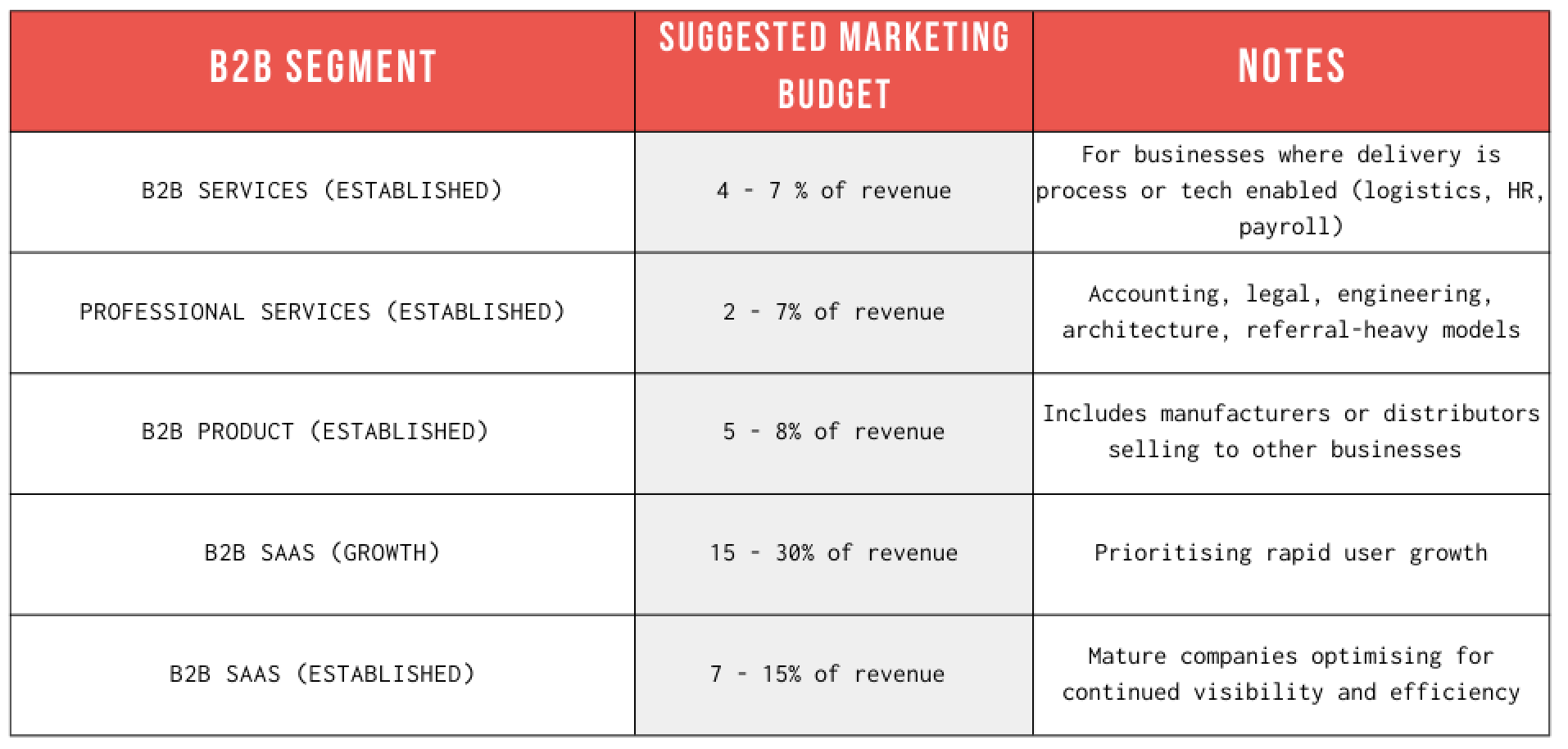
There is a full breakdown at the end of this article, but general B2B marketing budget guides range from 2% to 10% of their revenue into marketing. This figure refers to total marketing investment – not just ad spend. That means it includes media budgets, internal team resourcing, external agencies, content creation, tools, and technology.
To answer this question you need to look at:
- Your industry
- Your business maturity
- Your growth goals
When I answer this question, I like to go deeper and also take into account:
- Your competitors
- Revenue stability
- Sales cycle
- Customer lifetime value
- Internal resourcing
- Appetite for risk and experimentation
- Forecasting tools
Let’s break each point down.
Your Industry
It’s important to consider the realities of how your customers buy your products or services. How often do they buy? Where are they turning for information to guide their decision making?
This gives us clues not only into which marketing channels to use, but also the level of budget required to show up there. If your buyers are heavily influenced by events, conferences, niche publications or typically start their journey with a Google search, it’s a strong indication that you should be showing up there. This may justify an under or over investment of your company’s revenue into marketing. Ultimately, you have to be where your customers are.
Your Business Maturity
This is a major consideration in how much of your revenue should go toward marketing.
If you’re an established business, you’ve already built awareness in the mind of your target customers – people know who you are. Your job here is to remain top of mind and convince them you’re the best choice. Here I would take a lighter approach than if we were trying to raise the profile of a newer business with less brand awareness.
If you are a startup or newer business, you’re fighting a battle on two fronts – firstly you need to do the job of getting people to know you, in addition to convincing them you’re a great fit for their needs. This inevitably takes more time and money than a business that has already spent years laying this groundwork.
Your Growth Goals
Your marketing budget should reflect your level of ambition. If you have aggressive growth targets, it stands to reason that the investment needs to match. Scaling quickly requires more spend to build brand presence, generate pipeline and support sales.
Conversely, if your marketing goals are more modest and potentially not growth related, you can afford to take a lighter approach to marketing.
Your Competitors
Your industry will have its own characteristics and while the intention isn’t to just copy what your competitors are doing (there is real power in breaking the mould and doing what others aren’t) it is really important to tap into the competitive landscape for clues on where you should be playing, and how much you should be spending.
Say you’re a B2B professional services business and your top 3 closest competitors are all highly active on LinkedIn. For you to not also be there means you’re the only business not throwing your voice into the ring. You’re not being seen or heard – but your competitors are.
Be mindful also that your competitors are at 1 of 2 points on their marketing journey relative to you – less or more sophisticated. If you feel they’re more sophisticated, there’s generally a reason they’re pursuing the strategies they are. They likely have spent months or years experimenting with these strategies before you, and is a good indication that it has worked for them.
Getting a sense for where and how much your competitors are showing up also puts things into perspective – your competitors may have deeper pockets, but at least this gives you an insight into the level of investment you’d need to match or beat their efforts. And to the point above – where is the lower budget opportunity to zig where others are zagging?
Revenue Stability
Results in B2B marketing come from consistency and efforts compounding over time. That’s why revenue stability is an important factor when deciding how much to invest.
When partnering with businesses, I generally recommend a minimum commitment of 6 – 12 months to see meaningful impact.
If your revenue is predictable, especially if you’re working with your clients on recurring revenue or retainer models, you’ll likely feel more confident committing to a steady marketing investment.
If your revenue is project based, lumpy or unpredictable it makes sense to take a more conservative approach. In these cases, I recommend being cautious with how much you allocate to ongoing paid media or large campaigns. The priority here is building a consistent approach to marketing that you can sustain over time – not taking a stop/start approach that fluctuates.
Sales cycle
The reality of the B2B buying cycle is that it can take months to years to see the impact of marketing efforts. Your media budget needs to support and reflect this reality, and you have the opportunity to flex based on the reality of your sales cycle.
Longer sales cycles (i.e. 6 – 12 months+) need sustained investment over a longer period. If this is your reality, your budget needs to support consistent engagement over time. You’ll likely need to invest more in:
- Content nurturing (e.g. whitepapers, webinars, case studies)
- Lead nurturing tools (like marketing automation)
- SEO & AEO tactics to help your brand rank for relevant search queries
- Retargeting and remarketing ads
- Awareness and brand-building over time, not just lead gen
In these instances you need to account for delayed ROI, and temper expectations around quick campaign wins in 1 – 3 months. Campaigns and budgets need to be planning for the long term to reflect the reality of your sales cycle.
Conversely, if your sales cycle is shorter (1 – 3 months) your budget can reflect more of a campaign-driven approach, with a priority towards:
- Performance media (e.g. Google Ads, LinkedIn)
- Retargeting and remarketing ads
- Sales enablement content
The budgets and investment needed therefore can flex based on how much time and effort it takes to generate a sales qualified lead, plus the lag from lead > sale.
Customer Lifetime Value (CLTV)
If you have the opportunity for repeat business, or generate recurring revenue from your clients, this needs to be taken into account when allocating your overall media budget.
Instead of just looking at the budget needed to generate a new customer (Customer Acquisition Cost/CAC), think broader to the overall revenue potential a new customer has the ability to generate for you.
To calculate your customer LTV:
- For recurring revenue businesses:
Average Revenue per Customer × Gross Margin × Average Customer Lifespan - For projects:LTV = Average Purchase Value × Purchase Frequency × Average Lifespan
Internal resourcing
Any investment in B2B marketing needs to be supported by the right internal capacity. Before deciding how much to invest, consider how much time, expertise, and strategic input your internal team can realistically contribute. Even with great external partners, your success relies on someone inside the business who can collaborate, make decisions and help move things forward.
There’s little value in investing heavily if you don’t have the internal bandwidth to support rollout. A smaller, well-supported marketing program will outperform a bigger one that no one has time to action.
Appetite for risk and experimentation
Your mindset toward risk is a key factor when deciding how much to invest in marketing. Ask yourself: Are we comfortable with experimentation, or do we need to take a more conservative approach?
If you’re starting from scratch and don’t yet have proven marketing results, it often makes sense to start small. A more conservative approach lets you establish foundations, test the waters, and build confidence without overcommitting budget too early.
Conversely, if you have ambitious growth targets in a shorter timeframe, your marketing investment should reflect that urgency. In this case, you’ll likely need to allocate more budget upfront, including a healthy portion for experimentation. The faster you need to learn and scale, the more you’ll need to test.
I generally advocate for a balanced approach: a conservative leaning budget to start, with a separate portion of budget set aside for innovation and experimentation, and capacity to scale up pending results – particularly if marketing for the first time or exploring a new channel. This helps minimise wasted spend and philosophically allows you to appreciate the different purposes of your two buckets of investment.
It’s also worth recognising that innovation and efficiency are by definition at odds. Testing new things comes at a cost, and not every initiative will work. Being aware of that trade-off helps you set better expectations and allocate budget more intentionally.
Forecasting tools
Caveat – while forecasting tools are a helpful guide, they should never be treated as your single source of truth. In my experience, the most reliable way to benchmark performance is by looking at your own historical data – past campaigns, cost per lead, conversion rates, and pipeline performance all provide a clearer picture of what’s realistic for your business.
That said, if you’re starting from ground zero and don’t have internal data yet, forecasting tools are a really useful barometer. They can help estimate what kind of budget might be required to reach your goals and give you a rough idea of what’s happening / what’s possible within your market.
Some (but nowhere near all) include:
- SEO and visibility tracking tools like Ahrefs, SEMrush, and SimilarWeb
- Google tools like Google Trends, Keyword Planner, and Performance Planner
- AI engines to help with market research and forecast indications
- Ad libraries – Google, Meta & LinkedIn each offer a tool where you can see what competitor ads look like
Use these tools to inform your planning, but always layer in real-world context and ideally your own performance / insights.
So – with all that said, how much of your overall budget should be put towards B2B marketing?
THIS table below breaks down optimal ranges by B2B segment.
Table Sources:
Deloitte CMO Survey, Gartner CMO Spend Survey, Statista 2023 CMO Survey, Savage Brands Update 2025
This should arm you with all the tools you need to know how to move forward.
If you need a hand planning your B2B marketing budgets, drop me a line at stef@thehereandnow.com.au – happy to help.